

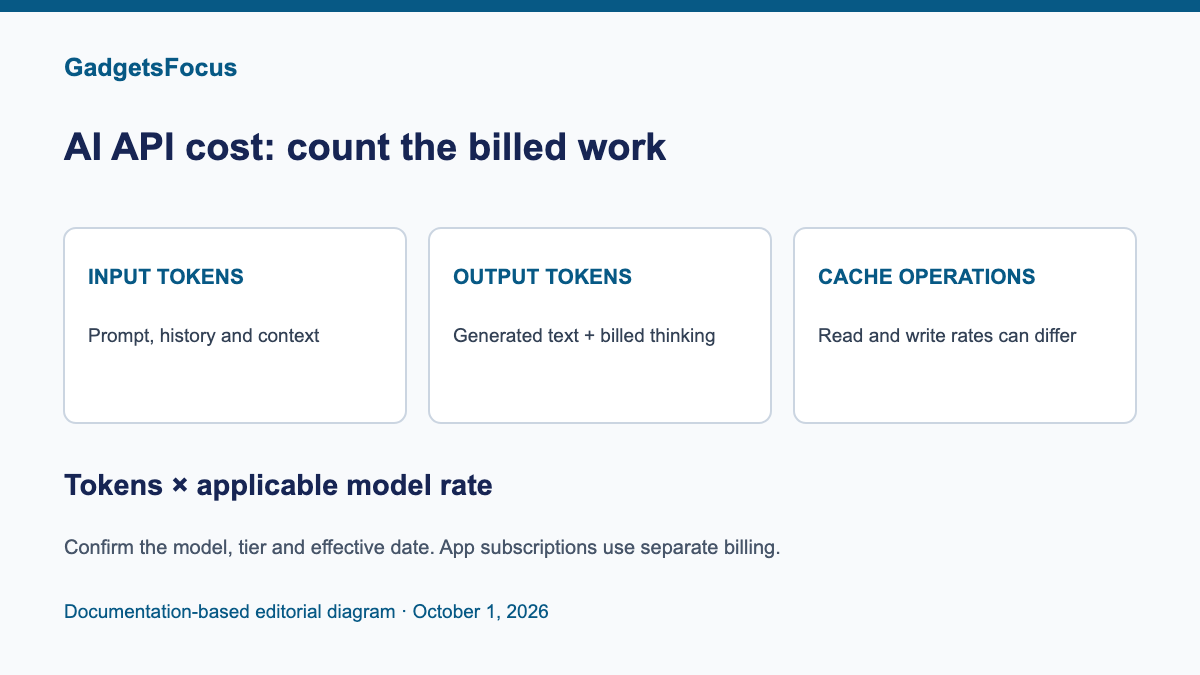


Verdict: Claude Sonnet 5.5, GPT-6.1 Sol, and Gemini 4 Argon all list standard API rates starting at $2.00 per million input tokens and $10.00 per million output tokens, subject to their applicable context tiers and caching rules. Following Google’s global general availability release of Gemini 4 Argon on October 13, 2026, developers can now deploy all three frontier models in production applications. However, Argon’s industry-first 1-million-token maximum output limit, up to 95% prompt caching discount, and post-introductory $4/$20 schedule introduce distinct token budgeting rules compared to Anthropic and OpenAI.
Rates checked October 13, 2026; USD per million tokens. This guide compares developer token billing and explains the underlying arithmetic. Consumer subscriptions, cloud reseller tiers, compute instance hosting, and optional tooling add-ons are priced separately.
Active Frontier API Rates Compared (October 2026)
| Model and scope | Input (per 1M) | Cached input read | Cache write | Output (per 1M) |
|---|---|---|---|---|
| Claude Sonnet 5.5, standard Claude API | $2.00 | $0.20 (90% off) | $2.50 for 5 min; $4.00 for 1 hr | $10.00 (128K max output) |
| GPT-6.1 Sol, Standard; up to 272K input tokens | $2.00 | $0.10 (95% off) | $2.50 | $10.00 (128K max output) |
| GPT-6.1 Sol, Standard; more than 272K input tokens | $4.00 | $0.20 | $5.00 | $15.00 (128K max output) |
| Gemini 4 Argon, Google AI Studio / Vertex AI (Live Oct 13) | $2.00 | Up to 95% off ($0.10–$0.20) | Standard write rate | $10.00 (1M max output) |
| Gemini 4 Argon, planned post-introductory rate | $4.00 | Up to 95% off ($0.20–$0.40) | Standard write rate | $20.00 (1M max output) |
Sources: Anthropic’s API price list, OpenAI’s API price list and GPT-6.1 Sol pricing conditions, and Google DeepMind’s Gemini 4 Argon documentation. For architectural differences and benchmark details, see our frontier model specification comparison and our complete guide to Gemini 4 Argon Explained.
A Cost Calculation You Can Reproduce
For an API request without caching, multiply input tokens by the input rate and billed output tokens by the output rate, dividing each by one million. Add any separately billed services.
Example: 10,000 ordinary input tokens and 2,000 total billed output tokens at $2/$10 cost $0.04: (10,000 ÷ 1,000,000 × $2) + (2,000 ÷ 1,000,000 × $10). This arithmetic applies directly to the stated standard rates for Sonnet 5.5, short-context GPT-6.1 Sol, and Gemini 4 Argon. It represents a baseline illustration rather than a benchmark measurement for a specific prompt.
Output length, repeated agentic calls, and multi-turn retries can change the final bill even when two models carry identical headline rates. Evaluate cost per completed task meeting your precision requirements, rather than assuming equivalent spending from the final answer’s visible character count.
Cache Writes and Cache Hits Have Different Costs
To reduce recurrent inference costs across massive codebases or documentation sets, all three providers support prompt caching. However, a repeated prefix must qualify for caching and produce an actual cache hit to earn the discount. Changing prompt prefixes, expiring cache TTL windows, or sending uncached system text will alter the total cost:
| Request state | Claude Sonnet 5.5 (5-min cache) | GPT-6.1 Sol (Standard) | Gemini 4 Argon (Live API) |
|---|---|---|---|
| Initial cache write plus output | $0.25 + $0.01 = $0.26 | $0.25 + $0.01 = $0.26 | $0.20 + $0.01 = $0.21 |
| Eligible cache hit plus output | $0.02 + $0.01 = $0.03 | $0.01 + $0.01 = $0.02 | $0.01 + $0.01 = $0.02 |
Notice that for high-volume developer workloads—such as repository-wide refactoring in Claude Code or Cursor—a 90% to 95% caching discount makes querying 100,000 tokens of project context cost only $0.01 to $0.02 per iteration.
Thinking Tokens Belong in the Output Budget
Both Anthropic and OpenAI bill reasoning and thinking tokens as output tokens, and Google applies the same policy to Gemini 4 Argon’s chain-of-thought tokens. A model’s bill cannot be predicted solely from the visible markdown text delivered to the user.
Crucially, because Gemini 4 Argon permits an output generation window of up to 1,000,000 tokens, an unconstrained autonomous reasoning loop could emit hundreds of thousands of thinking tokens. A single call producing 500,000 output tokens costs $5.00 at introductory rates ($10.00 at standard rates). Configuring sensible max_output_tokens ceilings in your API configuration is necessary to prevent runaway expenses.
Batch Rates and Costs Beyond Tokens
Anthropic offers a 50% discount on input and output for asynchronous Batch API requests. OpenAI provides a 50% discount for Batch and Flex modes below Standard rates. Google Cloud Vertex AI and Google AI Studio offer equivalent batch processing discounts for non-urgent enterprise evaluations.
When budgeting for autonomous engineering stacks, account for vector database retrieval, cloud sandbox execution, and human oversight time alongside raw token meters. Test a representative sample of bugs or documents to calculate your true monthly cost per resolved work item.
Frequently Asked Questions
Which model is cheapest for production deployment?
At standard rates below 272K input tokens, Claude Sonnet 5.5, GPT-6.1 Sol, and Gemini 4 Argon tie at $2.00 input / $10.00 output per million tokens. For tasks exceeding 272K input tokens, Gemini 4 Argon remains at $2.00 input during its launch period while GPT-6.1 Sol increases to $4.00 input / $15.00 output. For heavy thinking loops, setting strict output caps is critical on all three.
Can I use Gemini 4 Argon via API today?
Yes. Following its global release on October 13, 2026, Gemini 4 Argon is accessible via Google AI Studio and Google Cloud Vertex AI, as well as integrated into Google Antigravity.