
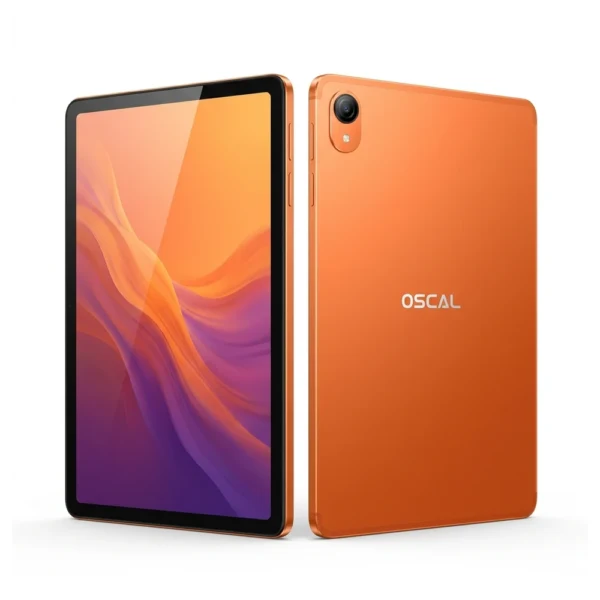
Oscal Bolt 2
-
Processor Unisoc T7250 / Tiger T615
-
Display 11.0 inches
-
Battery 8300 mAh Li-Po, non-removable
-
Camera 8 MP
Compare Oscal Bolt 2
Oscal Bolt 2: At a Glance
Oscal Bolt 2 has an 11.0-inch IPS LCD display, the Unisoc T7250 / Tiger T615 chipset, an 8 MP main camera and an 8300 mAh battery.
Show 7 more key specs
Specs
Network
| Technology | GSM / HSPA / LTE (4G Cellular / Wi-Fi Tablet) |
|---|---|
| 2G Network GSM 850 / 900 / 1800 / 1900 - SIM 1 & SIM 2 (dual-SIM) CDMA 800 / 1900 | GSM 850 / 900 / 1800 / 1900 |
| 3G Network | HSDPA 900 / 2100 |
| 4G Network | 1, 3, 7, 8, 20, 28, 38, 40, 41 |
| 5G Network | No |
| Speed | HSPA, LTE |
LAUNCH
| Announced | 2026, November |
|---|---|
| Status | Available. Released 2026, November |
BODY
| Dimensions | 257.0 x 168.6 x 8.4 mm (10.12 x 6.64 x 0.33 in) |
|---|---|
| Weight | 567 g (20.00 oz) |
| Build | Glass front, textured composite unibody back, flat frame |
| SIMs SIM (Subscriber Identity Module) is a small card that contains mobile network subscriber's account information. This allows the phone using the card to attach to a mobile network. The SIM card is most commonly associated with GSM and UMTS mobile networks. Moving a SIM card from one phone to another allows a subscriber to switch mobile phones without having to contact their mobile network carrier. SIM cards can also be used by a phone to store limited amounts of data, such as phone numbers and text messages. | Hybrid Dual SIM (Nano-SIM, dual stand-by) |
| Water Resistant | No |
Display
| Display Type Display Technology => A number of display technologies and types used in mobile phones => TFT (Thin Film Transistor), IPS (In-Place Switching), OLED (Organic Light Emitting Diode), AMOLED (Active-Matrix Organic Light-Emitting Diode), Super AMOLED (an even advanced version of AMOLED), Resistive Touchscreen (Resistive touchscreens contain two layer of conductive material with a very small gap between them which acts as a resistance), Capacitive Touchsceen (Capacitive touchscreen technology consists of a layer of glass coated with a transparent conductor) | IPS LCD, 90Hz, TÜV Low Blue Light |
|---|---|
| Size | 11.0 inches, 350.9 cm2 (~81.0% screen-to-body ratio) |
| Resolution | 800 x 1280 pixels, 16:10 ratio (~137 ppi density) |
| Protection Display Protection => Gorilla Glass is a special alkali-aluminosilicate glass shield with exceptional damage resistance that helps protect mobile displays from scratches, drops, and bumps of everyday use, It is always better to go for a smartphone with Gorilla Glass for that added protection and peace of mind. | Scratch-resistant glass |
PLATFORM
| Operating System OS => Every computer system run on a base software called Operating System (OS). Operating System controls all basic operations of the computer (such as smartphone, PDAs, tablet computers and other handheld devices). The Operating System allows the user to install and run third party applications (apps), apps are used to add new functionality to the device. | Android 16, DokeOS_P (PC Mode & Split Screen) |
|---|---|
| Chipset Chipset is a group of integrated circuits designed to perform one or a more dedicated functions, often with real time computing constraints, Popular smartphones are equipped with more advanced embedded chipsets that can do many different tasks depending on their programming. | Unisoc T7250 / Tiger T615 (12 nm) |
| CPU CPU (Central Processing Unit) mostly known as processors, CPU processes instructions in order to carry out certain functions that make your device operate properly. Processors are often described as the brain of computers, smartphones and tablets, Smartphones and tablets rely on processors to carry out their every task, Processors are an incredibly important factor in selecting any type of computing device, including your smartphone. | Octa-core (2x1.8 GHz Cortex-A75 & 6x1.6 GHz Cortex-A55) |
| GPU GPU (Graphics Processing Unit) is a single-chip processor designed to rapidly manipulate and alter memory to accelerate the creation of images in a frame buffer intended for output to a display, This includes things such as lighting effects, object transformations, and 3D motion. | Mali-G57 MP1 |
MEMORY
| Card Slot Memory Card Slot is a special slot for inserting a memory card. Memory cards allow you to expand the phone's built-in memory, A memory card (sometimes called a flash memory card or a storage card) is a small storage medium used to store data such as text, pictures, audio, and video, for use on small, portable or remote computing devices such as mobile phones, mp3 players, digital cameras. | microSDXC (uses shared SIM slot, up to 2TB) |
|---|---|
| Internal | 128GB 3GB RAM, 128GB 8GB RAM |
MAIN CAMERA
| Cameras Specs Today’s smartphones come equipped with a very comprehensive set of camera related specifications. Our smartphone, for many of us, has become our primary camera due to it being the one we always have with us. | 8 MP, AF |
|---|---|
| Camera Features | LED flash, document scan |
| Video | 1080p@30fps |
SELFIE CAMERA
| Cameras Specs Today’s smartphones come equipped with a very comprehensive set of camera related specifications. Our smartphone, for many of us, has become our primary camera due to it being the one we always have with us. | 5 MP |
|---|---|
| Features | Face unlock |
| Video | 720p@30fps |
SOUND
| Loudspeaker | Yes, with dual stereo speakers |
|---|---|
| 3.5mm jack | Yes |
COMMS
| WLAN | Wi-Fi 802.11 a/b/g/n/ac, dual-band |
|---|---|
| Bluetooth Bluetooth is a wireless communications technology for exchanging data between mobile phones, headsets, computers and other network devices over short distances without wires, Bluetooth technology was primarily designed to support simple wireless networking of personal consumer devices. | 5.0, A2DP, LE |
| Positioning | GPS, GLONASS, GALILEO, BDS |
| NFC NFC (Near field communication) is a set of standards for smartphones and similar devices to establish peer-to-peer radio communications with each other by touching them together or bringing them into proximity, usually no more than a few inches. | No |
| Infrared Infrared connectivity is an old wireless technology used to connect two electronic devices. It uses a beam of infrared light to transmit information and so requires direct line of sight and operates only at close range. | Not specified |
| Radio | No |
| USB | USB Type-C 2.0, OTG |
Features
| Sensors Sensors are electronic components that detects and responds to some type of input from the physical environment. The specific input could be light, heat, motion, moisture, pressure and location, The output is generally a signal that is converted to use in computing systems, a location sensor, such as a GPS receiver is able to detect current location of your electronic device. | Accelerometer, Hall sensor (keyboard/folio bundle support) |
|---|
BATTERY
| Battery Type Battery Type => Cell phones run on various kinds of batteries depending on the manufacturer, phone size or shape and features. There are basically four types of cell phone batteries => Lithium Polymer, Lithium Ion, Nickel Metal Hydride and Nickel Cadmium. | Li-Po, non-removable |
|---|---|
| Capacity Battery Capacity is a measure (typically in Amp-hr) of the charge stored by the battery, and is determined by the mass of active material contained in the battery. The battery capacity represents the maximum amount of energy that can be extracted from the battery under certain conditions. | 8300 mAh |
| Placement | Not specified |
| Charging The functionality responsible for recharging batteries in portable devices, such as mobile phones, significantly influences both battery lifespan and the practicality of daily product usage.The charging process, encompassing factors like voltage, current, and completion actions, is contingent upon the battery's size and type.Contemporary battery chargers dynamically adjust charging parameters based on the battery's current charging state. Charging an empty battery poses no safety risk, allowing for a quicker charging process. Consequently, many charging speed benchmarks, including ours, specify the battery level achieved after a 30-minute session on an empty battery.Standard chargers with a power output of 5V/1A, equivalent to 5W, serve as a baseline, with anything surpassing this speed classified as quick or fast charging. | 18W wired fast charging, 10W wired reverse charging |
MISC
| Colors | Sunset Orange, Space Grey |
|---|---|
| Model | OSCAL-BOLT2 |
| SAR SAR (Specific absorption rate): Each GSM handset has a radio transmitter and receiver in order to operate in the wireless GSM network. That transceiver is manufactured so that when used next to the ear and when worn on the belt, it won't exceed the limits for exposure to radio frequency energy set by the authorities.The authorities in question here are the Federal Communications Commission (FCC) of the U.S. Government, Industry Canada of the Canadian Government (IC), and the Council of the European Union. | Not specified |
| SAR EU Each GSM handset has a radio transmitter and receiver in order to operate in the wireless GSM network. That transceiver is manufactured so that when used next to the ear and when worn on the belt, it won't exceed the limits for exposure to radio frequency energy set by the authorities.The authorities in question here are the Federal Communications Commission (FCC) of the U.S. Government, Industry Canada of the Canadian Government (IC), and the Council of the European Union. | Not specified |
| Price | $199.00 / €199.00 / PKR 55,500 |
TESTS
| Performance | AnTuTu: 290,000 (v10) | Entry-level student & media tablet |
|---|---|
| Display | 11-inch 90Hz eye-care IPS LCD |
| Loudspeaker | Not specified |
| Battery (new) | 8300 mAh + 10W reverse powerbank charging |
Reasons to Buy (Pros)
- Value-packed 11-inch productivity tablet frequently bundled with a keyboard, mouse, and stylus at around $199
- Large 8,300 mAh battery supporting 18W fast charging AND 10W wired reverse charging to top up phones
- Smooth 90Hz TÜV eye-care display with 2TB microSD card expansion and DokeOS_P (Android 16) PC Mode
- Bold Sunset Orange and Space Grey finishes with dual-SIM cellular connectivity in an 8.4mm chassis
Reasons to Avoid (Cons)
- HD+ resolution across an 11-inch screen looks noticeably softer than the 2.3K Blackview Zeno 6
- Entry-level Unisoc T7250 (12nm) and 8MP/5MP cameras are meant for light browsing, schoolwork, and streaming
- Slightly heavier at 567g than similarly sized 11-inch slates
The Oscal Bolt 2 is a Oscal smartphone that pairs a 11.0 inches, 350.9 cm2 (~81.0% screen-to-body ratio) (IPS LCD, 90Hz, TÜV Low Blue Light) display with the Unisoc T7250 / Tiger T615 (12 nm) processor. Announced in 2026, November (Available. Released 2026, November), the device is positioned for buyers looking for a competitive option around 199.
Design and Display
On the outside, the Oscal Bolt 2 measures 257.0 x 168.6 x 8.4 mm (10.12 x 6.64 x 0.33 in) and weighs 567 g (20.00 oz), featuring a Glass front, textured composite unibody back, flat frame construction. The front is built around a 11.0 inches, 350.9 cm2 (~81.0% screen-to-body ratio) IPS LCD, 90Hz, TÜV Low Blue Light panel with a resolution of 800 x 1280 pixels, 16:10 ratio (~137 ppi density), giving users sharp text rendering and smooth scrolling for everyday browsing and media playback.
Performance, Software, and Memory
Powering the Oscal Bolt 2 is the Unisoc T7250 / Tiger T615 (12 nm) SoC (Octa-core (2×1.8 GHz Cortex-A75 & 6×1.6 GHz Cortex-A55)) paired with the Mali-G57 MP1 GPU. Memory configurations include 128GB 3GB RAM, 128GB 8GB RAM (Card slot: microSDXC (uses shared SIM slot, up to 2TB)). Out of the box, the phone runs Android 16, DokeOS_P (PC Mode & Split Screen).
Camera Configuration
For photography, the rear camera setup consists of: 8 MP, AF. Video capture on the main system supports 1080p@30fps. On the front, selfie duties and video calls are handled by a 5 MP camera.
Battery Life, Charging, and Connectivity
Battery capacity is rated at 8300 mAh (Li-Po, non-removable), with charging support rated at 18W wired fast charging, 10W wired reverse charging. Connectivity options include Wi-Fi (Wi-Fi 802.11 a/b/g/n/ac, dual-band) and USB Type-C 2.0, OTG.
Oscal Bolt 2 — Frequently Asked Questions
What processor and storage options does the Oscal Bolt 2 have?
The Oscal Bolt 2 is powered by the Unisoc T7250 / Tiger T615 (12 nm) chipset with an Octa-core (2x1.8 GHz Cortex-A75 & 6x1.6 GHz Cortex-A55) CPU and Mali-G57 MP1 GPU. Memory and storage configurations include 128GB 3GB RAM, 128GB 8GB RAM.
What is the battery capacity and charging speed of the Oscal Bolt 2?
The Oscal Bolt 2 comes with a 8300 mAh battery (Li-Po, non-removable) and supports 18W wired fast charging, 10W wired reverse charging.
How good is the Oscal Bolt 2 camera setup?
On the rear, the Oscal Bolt 2 features 8 MP, AF. It supports video recording at 1080p@30fps. For selfies, it includes a 5 MP front camera.
Does the Oscal Bolt 2 support 5G, NFC, and a headphone jack?
Network connectivity on the Oscal Bolt 2 includes HSPA, LTE. NFC support: No. 3.5mm headphone jack: Yes.
What is the price and release status of the Oscal Bolt 2?
The estimated retail price of the Oscal Bolt 2 is around $199. Market status: Available. Released 2026, November. Available colorways include Sunset Orange, Space Grey.
Reviews
Disclaimer Note
We strive to maintain accurate and up-to-date content on our website for general information purposes only. Please refrain from using the material for business, legal, or any other decisions.
New Arrivals
Comparisons with this phone


Top Rated
-
 Editorial score 9.8 out of 10
ZTE nubia RedMagic 12 Pro+
-
 Editorial score 9.8 out of 10
ZTE nubia RedMagic 12 Pro
-
 Editorial score 9.8 out of 10
Samsung W27
-
 Editorial score 9.8 out of 10
Oppo Reno17 Pro 5G
-
 Editorial score 9.8 out of 10
Oppo Reno16 Pro 5G
-
 Editorial score 9.8 out of 10
Huawei Pura X View